The Era of Neuro-Somatic Intelligence: Why You Can’t Think Your Way Out of Stress
Logic is a blunt tool for a biological crisis. We’ve spent years analysing our minds, yet we remain stuck in stress loops. The frontier of 2026 isn't mental—it's neuro-somatic. Discover how to stop thinking and start regulating your nervous system by hacking the Vagus Nerve superhighway.

We have spent the last decade obsessing over "Mental Health."
We talk. We analyse. We journal. We try to use logic to dismantle the tightness in our chest or the fog in our brain. But for many of us—especially those navigating intense environments or managing neurodivergent traits—this top-down approach hits a ceiling.
Why? Because you cannot think your way out of a sensation.
In 2026, the frontier of human performance is no longer just about managing your time or your mindset. It is about managing your biology. It is about Nervous System Regulation.
This is the essence of Neuro-Somatic Intelligence: the ability to read your body’s dashboard and manually adjust the dials, rather than just staring at the check engine light and hoping it goes away.
The Reality of "Bio-Lag"
I speak about this not as a guru, but as someone who lives in the arena with a distinct operating system.
I have many brilliances. I can process complex patterns, sustain extreme physical endurance, and lock into hyperfocus. But I also have challenges that I need to manage.
One of the most profound is delayed emotional processing.
I don’t always process stress and anxiety in a straightforward, linear way. When a high-pressure event happens, I might feel numb or hyper-competent in the moment. My biology overrides the emotion to get the job done.
But the body keeps the score.
Days later, when the threat is gone, the crash comes. The anxiety arrives not as a thought, but as a physical wall—a dysregulated state that logic cannot penetrate. I am unable to control the inputs that trigger this, but I have learned that I can manage the processing.
This is where meditation and breathing exercises stopped being "nice-to-haves" and became non-negotiable infrastructure. They are the tools I use to regulate a nervous system that often runs hot.
What is Nervous System Regulation?
Nervous System Regulation is the biological ability to move fluidly between states of arousal (mobilisation) and rest (safety), rather than getting stuck in a chronic stress response. It is not about being calm all the time; it is about having a braking system that works as well as your accelerator.
The Hardware: A Brief Look Under the Hood
To understand regulation, we have to look at the Autonomic Nervous System (ANS). Think of it as the operating system running in the background of your body. It has two main branches:
- The Sympathetic Nervous System (The Accelerator): This is your "Fight-Flight" mode. It dumps cortisol and adrenaline into your blood. It is brilliant for lifting a heavy weight or meeting a deadline.
- The Parasympathetic Nervous System (The Brake): This is your "Rest and Digest" mode. It slows the heart, aids digestion, and allows for social connection and recovery.
The problem isn't the accelerator. The problem is that modern life—with its constant notifications, caffeine, and micro-stressors—has jammed the pedal to the floor.
We aren't returning to baseline. We are living in a state of functional freeze or chronic activation. We are burning out not because we are doing too much work, but because we are doing too much feeling without enough processing.
The Myth of "Just Calm Down"
If you have ever told someone in a panic attack to "just calm down," you know how ineffective it is.
From a Stoic perspective, we try to control our judgments. But from a biological lens, we have to acknowledge that the "thinking brain" (the prefrontal cortex) actually goes offline when the nervous system detects a threat.
You are trying to upload software (logic) to a computer that has crashed (biology).
This is particularly acute for the neurodivergent (AuDHD) community. For us, the sensory gates that filter out noise often stay open. The hum of a fridge, the texture of a shirt, or the emotional tone of an email can trigger a sympathetic response.
This isn't a character flaw. It isn't a lack of discipline. It is a hardware reality.
If your "brake pedal" is faulty, you don't need a lecture on driving safety. You need a mechanic to adjust the cable.
Enter the Vagus Nerve: The Body’s Superhighway
The "mechanic" in this metaphor is the Vagus Nerve.
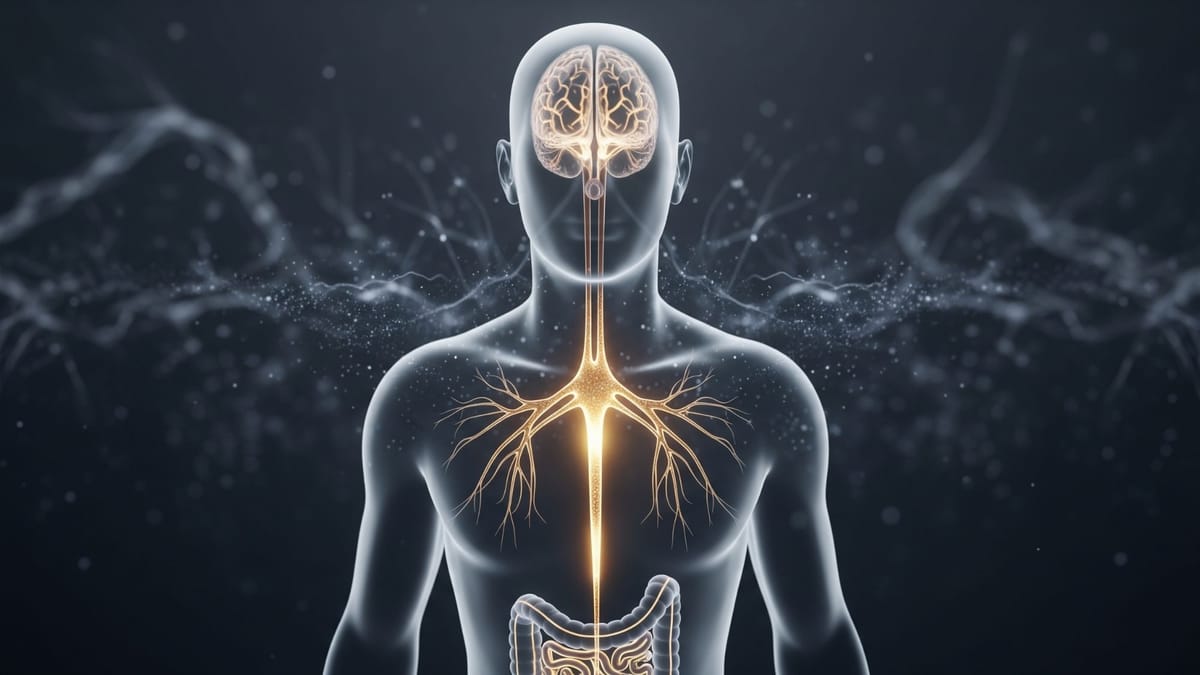
It is the longest cranial nerve in the body, wandering from your brainstem down to your heart, lungs, and gut. It is the primary data cable for the parasympathetic nervous system.
When we talk about "Vagal Tone," we are talking about the strength of this connection.
- Low Vagal Tone: You struggle to switch off. You feel anxious, have poor digestion, and experience brain fog. You stay stuck in the stress response long after the stressor is gone.
- High Vagal Tone: You bounce back. You can navigate stress and return to a state of safety quickly. This is the biological definition of resilience.
The exciting part? You can manually stimulate this nerve. You can hack the system.
The Vagus Nerve Reset (Neuro-Somatic Practice)

In the "Laboratory of the Mind," I have experimented with dozens of protocols. I have found that while cognitive frameworks are essential for long-term mindset shifts, the most effective tools for an immediate change in state are somatic. They involve the eyes, the breath, and the neck.
This specific Vagus Nerve Reset is a neuro-somatic practice designed to send a direct signal of safety to your brainstem. It bypasses the "story" of why you are stressed and goes straight to the physiology.
I have recorded a guided session to walk you through this. It combines specific eye movements (which connect directly to the suboccipital muscles and the vagus nerve) with a rhythmic breathing pattern.
Watch the Guided Session Here:
Why This Works
When you perform these specific eye movements and breathing holds, you are engaging what is known in the biological space as the Oculo-Cardiac Reflex.
In my practice, I view this as a biological toggle. You are physically stretching the muscles at the base of the skull where the vagus nerve exits. This mechanical action, combined with the slow exhale, signals the heart rate to decelerate.
You might feel a yawn, a sigh, or a swallow. That is the "reset." That is the moment your body shifts gears from Sympathetic (Survival) to Parasympathetic (Safety).
From "Coping" to "Capacity"
The goal of Neuro-Somatic Intelligence isn't just to use these tools when you are crashing. That is reactive. The goal is to build capacity.
Think of your nervous system like a muscle. If you only train it when you are injured, you will never get strong.
By practicing regulation when you don't need it, you widen your window of tolerance. You create a buffer. This means that when the inevitable stress of life arrives—or when that delayed emotional processing kicks in—you have the biological bandwidth to handle it.
Building Your Ecosystem of Regulation
This Vagus Nerve Reset is a powerful anchor, but it works best as part of a broader ecosystem of regulation tools.
For example, I use Pink Noise to create a sensory-safe environment for deep work. It masks the acoustic triggers that often spike my cortisol.
Similarly, throughout the day, I rely on The Double Five Breath. It is a pocket-sized version of regulation that I can use in a meeting or between sets of pull-ups.
Conclusion: The Body Keeps the Score (Until You Reset It)
If you take one thing from this, let it be this: You are not broken.
If you feel overwhelmed, anxious, or stuck, it does not mean you are weak. It likely means you are unregulated.
We live in a world designed to dysregulate us. The algorithm, the news cycle, the lighting in your office—it is all input. You cannot always control that input. But you have absolute agency over how you process it.
The tool is in your hands. It is in your breath. And it is in your nervous system, waiting to be reset.
Frequently Asked Questions (FAQs)
What are the symptoms of a dysregulated nervous system?
Common signs include chronic anxiety, digestive issues (bloating/IBS), sensitivity to light and sound, difficulty sleeping ("tired but wired"), and emotional reactivity or numbness.
How long does a vagus nerve reset take to work?
The immediate physiological shift (a sigh, yawn, or drop in heart rate) can happen within 60 to 90 seconds. However, long-term improvements in vagal tone require consistent daily practice over several weeks.
Is nervous system regulation good for ADHD?
Many in the neurodivergent community find that regulation techniques are essential infrastructure for managing sensory overwhelm. For those of us with an ADHD or Autistic operating system, shifting the brain out of a "freeze" state helps reclaim focus and executive function.
The principles discussed are not a substitute for professional advice. Individual results from applying these concepts will vary, as your unique path, choices, and consistent efforts play the most significant role in your experiences. If you require guidance regarding specific personal, financial, medical, or mental health situations, please consult with a qualified professional. Please engage with these ideas responsibly, understanding that you are the architect of your choices and actions.