The Algorithm Cannot Hear Your Heartbeat: Why AI Will Never Replace the Human Coach
AI can simulate a conversation, but the algorithm cannot hear your heartbeat. In an age of commoditised knowledge, the "Biological Moat" is the only advantage left. Here is why the future of coaching isn't data—it's nuance.


In the high-stakes world of the television drama Billions, Wendy Rhoades is not an "HR representative." She does not handle payroll, and she does not organise team-building retreats.
She is a performance coach sitting at the right hand of a hedge fund titan, acting as a mechanic for the high-performance mind. Her role is to strip away the psychological debris that slows down the machine.
You do not need to have seen the show to understand the archetype she represents. She provides a "Psychological DMZ" (Demilitarised Zone)—a space of zero judgment where intellects can drop their armour and confront their reality.
As Artificial Intelligence begins to dismantle and rebuild the modern workplace, a question is echoing through boardrooms: If an AI can answer any question, solve any logical problem, and organise our lives, do we still need human coaches?
The answer lies in a simple distinction. AI can simulate a conversation, but the algorithm cannot hear your heartbeat.
The Commodity of Knowledge
For centuries, "being educated" was the moat that separated the leader from the layperson. If you studied English Law, you held a key that others did not.
Today, that moat has dried up. A junior associate—or a teenager in a bedroom—can query an LLM (Large Language Model) like ChatGPT or Claude and retrieve a synthesis of English Law case studies in seconds. Knowledge is no longer power; it is a utility, as accessible as running water.
What is the "Information Gain"?
Strategic Human Coaching is the art of applying wisdom to knowledge. While AI provides the "what" (data and logic), the human coach provides the "how" (context and emotional regulation) and the "why" (purpose and values).
It does not matter what your team knows. It matters what they do with what they know when the pressure mounts. AI can give you the roadmap, but it cannot sit in the passenger seat and keep your hands steady on the wheel when you are terrified of the speed.
The Biological Moat: What the Algorithm Misses
We are seeing a rapid proliferation of "AI Coaches"—apps designed to prompt you into productivity. These tools are incredible for organisation and surface-level accountability. But they fail at the precise point where humanity begins: Nuance.
AI is a synthesis of logic. Humans are a messy contradiction of emotions.
Emotional Intelligence (or what I call the "unseen algorithm") is not something an AI can "learn" in the felt sense. It can process the definition of anxiety. It can list the symptoms of burnout. It can suggest a breathing protocol.
But it does not know what it feels like to have a tightening chest at 3:00 AM. It does not know the specific, heavy texture of grief or the paralysing grip of Imposter Syndrome.
The Viking Paradox
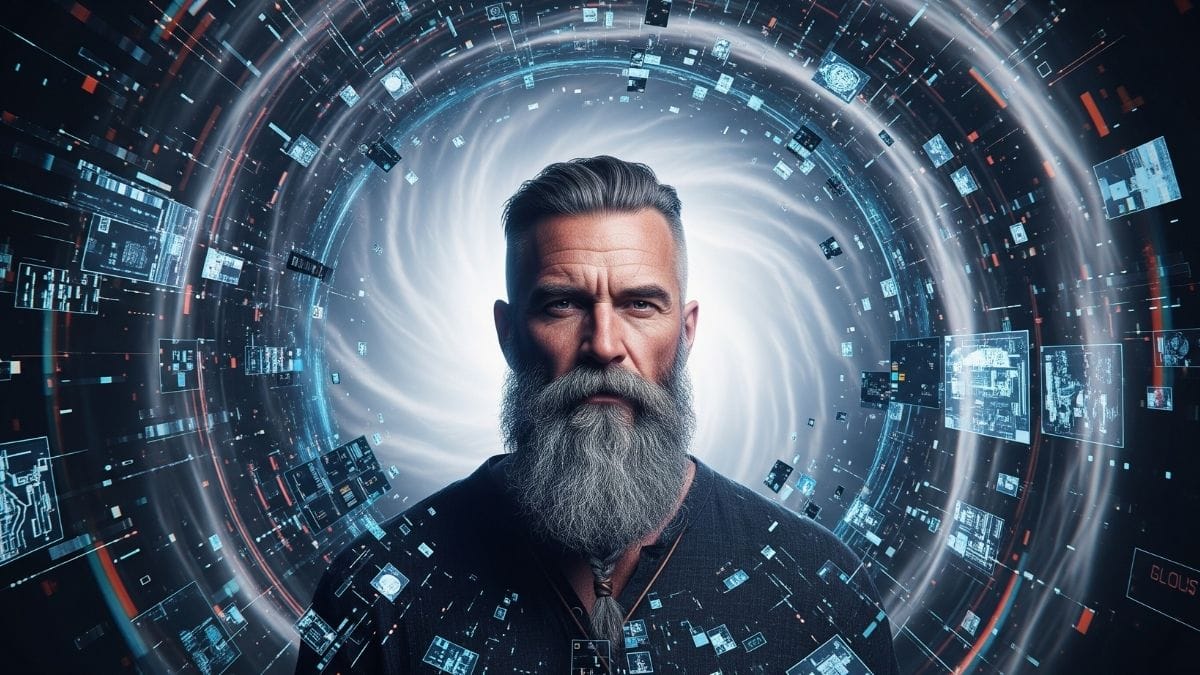
I have spent years navigating this duality in the "Laboratory of the Mind." To the outside world, I present a certain archetype. I am 6ft tall, sport a large grey beard, and I look like a Viking. The visual data suggests "toughness," "dominance," and "extroversion."
If an AI were to profile me based on visual sensors and biographical data, it would likely cater its responses to that "Viking" stereotype.
The reality, however, is that for years, a secret devil sat on my back: social anxiety and exhaustion. I have stood in rooms where I looked like the most confident person present, while internally, my nervous system was firing "threat" signals.
An AI cannot see past the mask. It listens to the words you say. A human coach listens to the silence between the words. A human coach feels the incongruence between your posture and your tone. When I work with a client, I am not just processing their language; I am sensing their "drift." I can feel when someone is performing a version of themselves because I have lived it.
That ability to say, "I hear what you're saying, but I feel like you're hiding something from yourself right now," is the Biological Moat. It is the distinct human advantage that allows us to lead with intuition rather than just calculation.
The Coach as a Strategic Function

We need to reframe the role of the coach in the modern organisation. For too long, coaching has been viewed as "remedial"—something you give to a manager who is struggling, or a "perk" for the C-Suite.
This is a fundamental misunderstanding of human performance.
In an AI-driven world, the role of the coach is that of an Architect of Culture. As AI agents automate the process-driven tasks, the human workforce moves exclusively into roles requiring high-level critical thinking, creativity, and interpersonal strategy.
These are high-cognitive-load activities. They require a regulated nervous system that is protected from constant digital urgency.
A coach acts as an integral part of the company's fibre, working with multi-level stakeholders to:
- Dismantle Silos: Facilitating communication between departments that AI might efficiently segregate.
- Regulate Fear: AI creates existential dread regarding job security. A coach converts that threat response into adaptability, helping teams see AI as a tool rather than a replacement.
- Create Psychological Safety: You cannot "prompt-engineer" trust. Innovation requires the safety to fail. A human coach cultivates the environment where failure is viewed as data, not disaster.
The Business Case
From a purely pragmatic standpoint, the investment in human coaching is often more efficient than the turnover costs of burnout. Whether through a permanent internal role or a strategic relationship with an external freelance coach, organisations are purchasing "insurance" for their decision-making capabilities.
(It is also worth noting that for many businesses, investing in external coaching and training is a tax-efficient utilisation of capital that directly appreciates the value of their human assets).
The Missing Jigsaw Piece
We are entering an era where authenticity is the new currency. In a digital landscape flooded with synthetic media, AI-generated emails, and automated responses, the "Human Signal" is becoming rare and valuable.
Senior leaders do not need more information. They are drowning in it. They need a space to process that information without fear of judgment.
An AI cannot judge you, which sounds like a benefit. But because it cannot judge, its acceptance means nothing. It is indifferent code. When a human being—who has their own biases, history, and emotions—chooses to sit with you, listen to you, and not judge you, that is where the transformation happens. That is where courage lives.
The future of work isn't "Human vs. Machine." It is "Human supported by Machine, guided by Human."
We will use AI to clarify English Law. We will use AI to schedule our meetings. We will use AI to analyse our biometrics.
But when it comes to the terrifying, exhilarating work of becoming who we are meant to be?
We need each other.
Frequently Asked Questions (FAQs)
Can AI replace executive coaching?
While AI can handle accountability and data analysis, it cannot replace the nuance, empathy, and "biological moat" of a human executive coach. High-stakes decision-making requires emotional intelligence that algorithms currently lack.
What is the role of a performance coach in an AI world?
In an AI-driven world, a performance coach acts as an "Architect of Culture," helping teams regulate their nervous systems, manage the anxiety of rapid change, and maintain the psychological safety required for innovation.
Why is "Information Gain" important in coaching?
Information Gain refers to the unique, human insight a coach adds beyond raw data. Since AI makes knowledge a commodity, the value of a coach lies in wisdom, context, and the ability to navigate complex human emotions.
The principles discussed are not a substitute for professional advice. Individual results from applying these concepts will vary, as your unique path, choices, and consistent efforts play the most significant role in your experiences. If you require guidance regarding specific personal, financial, medical, or mental health situations, please consult with a qualified professional. Please engage with these ideas responsibly, understanding that you are the architect of your choices and actions.