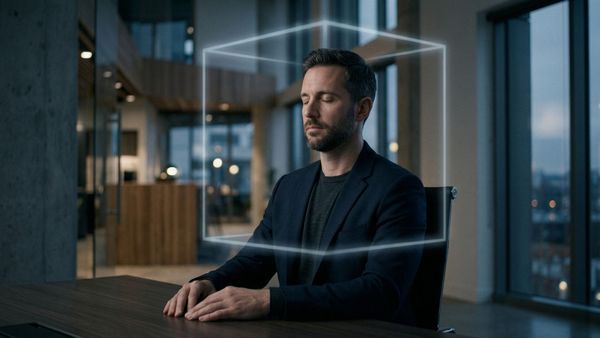
The New Intelligence Stack: Why the Future Belongs to the 'Human' Mind
We are moving from a hierarchy of authority to a hierarchy of competence. If you are neurodivergent, 'obsessive,' or simply different, the future of work doesn't just include you—it was built for you.


There is a scene in The Matrix where Neo, plugged into the training construct, opens his eyes after a rapid data upload and calmly states: "I know Kung Fu."
For years, I have viewed this scene not as science fiction, but as a perfect metaphor for the neurodivergent brain when it locks onto a "special interest."
I have always possessed a strange ability to adapt. When a subject doesn't interest me, learning it feels like wading through treacle. But when I switch it on—when I find the "Why" and connect with a topic authentically—I develop an insatiable palette for it. I don't just learn it; I consume it. I feel like Neo. I download the data, map the patterns, and suddenly, I know the system better than people who have been studying it for years.
For a long time, the corporate world labelled this trait as "inconsistent" or "scattered." They wanted specialists who stayed in their lane for thirty years.
But the world has changed. The lane has disappeared.
We are entering an era where your job title is the least interesting thing about you. As Artificial Intelligence flattens organisational structures and democratises access to the world’s knowledge, we are seeing the collapse of "Credentialism" and the rise of "Capability."
This is the new reality: The future doesn't belong to the person with the loudest voice or the grandest title. It belongs to the human with the best Operating System.
The Death of the "Title" & The Rise of the Human
We all know the archetype. The manager who has coasted on a title for a decade. The CEO who commands a room because of the letters after their name, not the ideas in their head. In the old world, opaque hierarchies allowed mediocrity to hide behind status.
Technology is stripping away those hiding spots.
As organisations flatten and AI tools allow a junior employee to out-produce an entire legacy department, we are witnessing a shift from a Hierarchy of Authority to a Hierarchy of Competence.
This is extremely good news for exceptional talent that has historically been overlooked. Perhaps they didn't have the right degree. Perhaps they didn't go for drinks after work to play the political game. Perhaps they weren't the loudest voice in the meeting room.
In 2026 and beyond, none of that matters. If everyone has access to the same AI models and the same information, the variable is no longer what you know. It is how you think, how you connect, and how you adapt.
We need to stop talking about IQ (Intelligence Quotient) and EQ (Emotional Quotient) as the only metrics of success. To thrive in this new landscape, we need to upgrade to a new intelligence stack: AQ, TQ, and HQ.
The New Intelligence Stack

1. AQ (Adaptive Intelligence)
What is Adaptive Intelligence? Adaptive Intelligence (AQ) is the measure of an ability to unlearn outdated knowledge and rapidly relearn new skills in response to changing environments. Unlike fixed IQ, AQ is the primary predictor of success in the AI era.
This is where the neurodivergent mind often has a distinct, unfair advantage. What the clinical world calls "hyperfixation," I call a High-Speed Learning Protocol.
When I am fascinated by a complex realm—like the intricacies of AI—I don't just dabble. I immerse. This ability to "download Kung Fu" is the essence of AQ. In a world where the technological landscape changes every six months, the person who relies on what they learned at university ten years ago is obsolete. The person who can obsessively learn a new framework over a weekend is invaluable.
2. TQ (Technical Quotient)
This is not about knowing how to code in Python. It is about Leverage.
TQ is the ability to understand how human capability interacts with machine capability. I use AI extensively, not to replace my thinking, but to handle the cognitive load of tasks that drain my energy. It saves me time and money, adding immense value to my life by clearing the path for the work that actually matters.
The high-TQ leader doesn't fear AI; they direct it. They understand that AI is the engine, but the human is the steering wheel.
3. HQ (Human Quotient)
This is the biological moat. The one thing the algorithm cannot replicate.
Think of Will Hunting from Good Will Hunting. He didn't study in the traditional sense; he had a raw, natural gift. In the coming decade, the "Will Hunting" genius won't just be mathematical—it will be relational.
There are people who are naturally gifted at communicating—not through text, not on a generic email, but face-to-face. They can read the micro-expressions in a room. They can sense when a "I'm fine" actually means "I'm drowning."
As we discussed in The Art of Being Understood, being seen and heard is a fundamental human need. AI can write a strategy document, but it cannot make a team member feel safe. It cannot empathise. It cannot sit in the mud with you.
As the workforce changes and older generations retire, we will see a premium placed on these "soft skills." But let’s be clear: they are not soft skills. They are Survival Skills.
The "Contradiction" is the Feature
I often feel like a walking contradiction.
I crave structure and organisation to keep my days running smoothly. Yet, simultaneously, I thrive on complex problems that act as complete disruptors. I can feel deep, overwhelming empathy for a friend in distress, yet in a genuine crisis, I can switch off the emotion, go completely logical, and function like a machine.
For years, I thought this duality was a bug in my system. I now realise it is a feature.
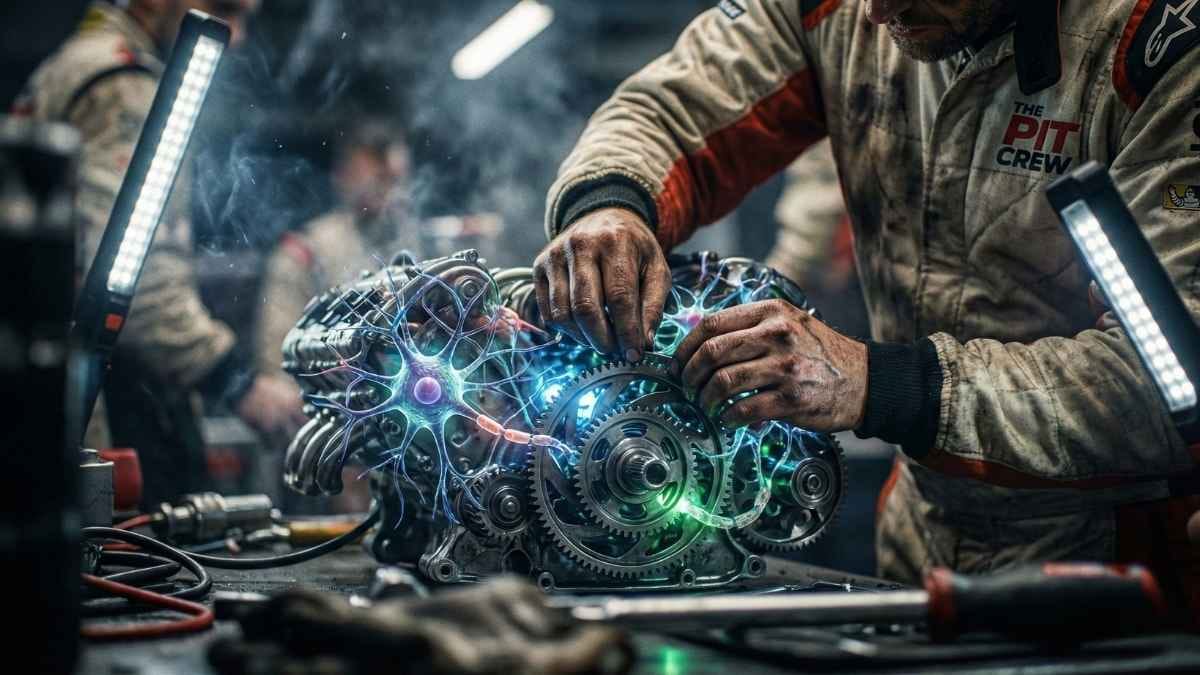
I liken it to being in a Formula 1 pit crew. To be a great coach or a great leader, you need to have been in the pit yourself. I have been broken. I have been a mess. I have had to rebuild my own engine while the race was still going on.
Because of this, when I work with someone, I’m not just offering platitudes. I am analysing the telemetry. I am looking at their unique idiosyncrasies—their challenges and their strengths—and helping them fine-tune the car.
This is the power of the neurodivergent experience in leadership. We have spent our lives manually operating a nervous system that others run on autopilot. We know how the gears grind. That awareness allows us to help others in a way that a "naturally smooth" operator simply cannot.
The Algorithm Cannot Hide You
We are moving into a world of transparency.
As technology advances, there are fewer places for people to hide inside their roles. You can no longer outsource your competence to your job description.
If you are a "Manager" who doesn't actually manage human emotions, AI will expose you. If you are a "Creator" who lacks a unique point of view, AI will replace you.
But if you are a human who can listen actively, who can adapt obsessively (AQ), who can leverage tools effectively (TQ), and who can connect deeply (HQ)—you are untouchable.
This is the signal for the quiet ones. The ones who don't go for drinks after work. The ones who were told they were "too intense" or "too sensitive."
Your intensity is your AQ. Your sensitivity is your HQ.
The world doesn't need more titles. It needs more humans who know Kung Fu.
Frequently Asked Questions (FAQs)
Is AQ more important than IQ?
In a stable world, IQ (processing speed/logic) reigns supreme. In a volatile, rapidly changing world, AQ (adaptability) wins. You can be a genius, but if you cannot unlearn old patterns, you will be left behind by a generic AI that adapts faster than you.
Can I improve my TQ if I'm not "techy"?
Absolutely. TQ isn't about coding; it's about mindset. It is the willingness to ask, "How can a tool help me do this better/faster?" Start by using AI to automate the tasks you hate, freeing up energy for the tasks you love.
How does neurodivergence fit into leadership?
Neurodivergent traits—such as pattern recognition, hyper-focus, and high empathy—are critical leadership assets in a complex world. See The Superpower Hidden in the Noise for more on channelling these traits.
The principles discussed are not a substitute for professional advice. Individual results from applying these concepts will vary, as your unique path, choices, and consistent efforts play the most significant role in your experiences. If you require guidance regarding specific personal, financial, medical, or mental health situations, please consult with a qualified professional. Please engage with these ideas responsibly, understanding that you are the architect of your choices and actions.