The Pre-Event Paradox: Why Your Nerves are Actually Your Greatest Performance Asset
Most people attempt to suppress their energy before a big event. This is a biological mistake. Discover why your "nerves" are actually your greatest performance asset and how to use a 8-minute protocol to lock in.
It begins in the quiet.
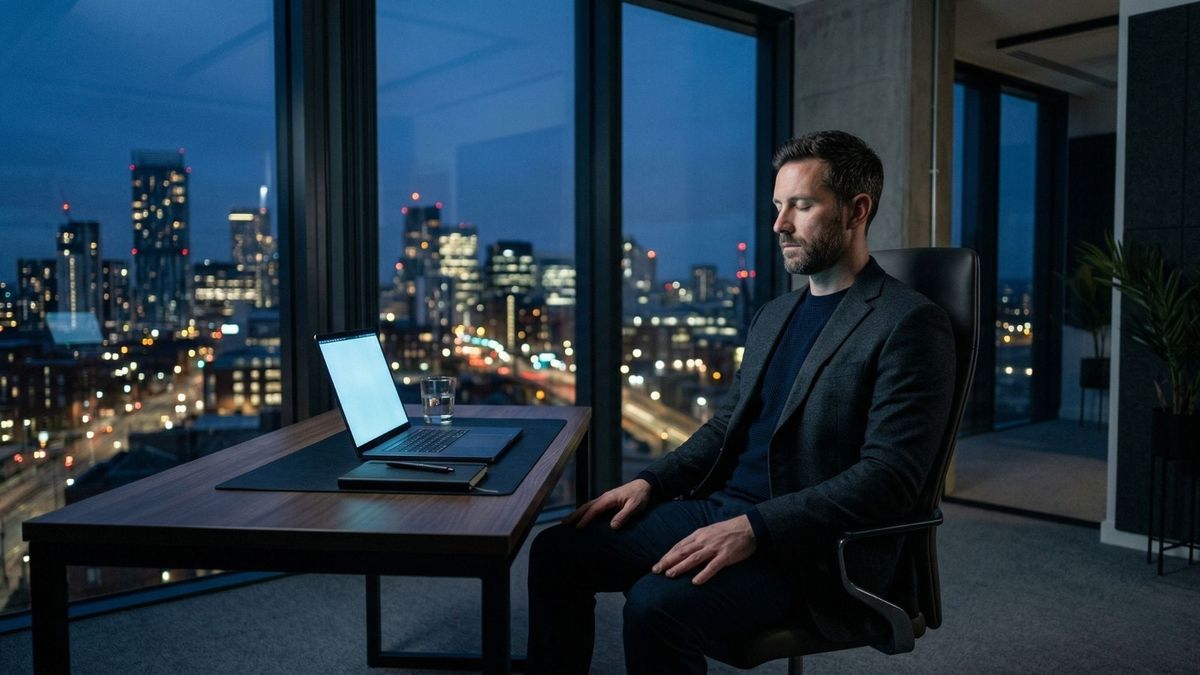
Perhaps it is thirty minutes before you are due to walk onto a stage to deliver a company-wide presentation. Maybe it is the five-minute countdown before a high-stakes Google Meet that could redefine your career trajectory. Or perhaps it is the silence in the corridor before you step into a room to have the difficult conversation you have been rehearsing for weeks.
In those moments, the body speaks. Your heart rate climbs. Your palms might dampen. There is a buzzing, scattered energy that feels like a physical weight in your chest.
Most people—even high-level leaders—label this sensation as "anxiety." They tell themselves to "calm down." They attempt to push the energy away, treating it like an intruder that needs to be evicted before they can perform.
This is a fundamental misunderstanding of your own biology.
That energy is not an intruder. It is an invitation. It is your nervous system's way of providing the raw fuel required for peak performance. The goal is not to extinguish the fire; it is to focus the flame.
What is Pre-Event Focus?
Pre-event focus is a targeted neuro-somatic state where an individual deliberately channels physiological arousal into cognitive clarity and executive function. Rather than suppressing the body's sympathetic nervous system response, this state uses structural protocols—such as rhythmic breathwork and mental rehearsal—to regulate the system for precision and unshakeable presence.
The Bio-Hacker’s Reframe: From Anxiety to Arousal

To perform at your highest level, you must stop fighting your own chemistry.
When you perceive a high-stakes event on the horizon, your sympathetic nervous system activates. It floods your system with cortisol and adrenaline. In a survival context, this prepares you to run or fight. In a professional context, it prepares you to be sharp, alert, and responsive.
The problem is not the presence of this energy; it is the lack of a steering wheel.
When this energy is unmanaged, it becomes performance anxiety—a loop of "what-if" thinking that consumes your cognitive bandwidth. But when you apply a structural protocol, you transition into what psychologists call "Optimal Arousal."
In this state, you are not "calm" in the sense of being sleepy or relaxed. You are regulated. You are a high-performance engine that is idling at the red line, ready to be engaged. You have moved from a state of being "under threat" to a state of being "in command." This is the foundational shift required to move from a reactive posture to a proactive execution.
The Laboratory of the Mind: Rehearsing the Unseen

I have spent years working with leaders, athletes, and entrepreneurs in what I call the "Third Space"—the unbiased strategic ground outside the echo chamber of their daily operations.
In this space, we do not just talk about the event; we build the rehearsal for it.
I have watched high-level performers sit in silence, eyes closed, physically vibrating with the energy of a pending launch or a critical negotiation. They are not just "hoping" for a good outcome. They are using their mind as a laboratory, running simulations of the next hour.
They are practising the moment before it happens.
This is not daydreaming. It is a deliberate, neuro-somatic rehearsal that aligns the mind and body. We work on the "start sequence"—the specific breath, the specific thought, and the specific physical anchor that signals to the brain: The preparation is complete. We are ready.
Not everyone has a partner in that "Third Space" in the final minutes before the clock starts. This is why I create guided practices. I want to provide that same level of structural support to anyone, anywhere, so they can access their highest focus on demand. By using a Nervous System Regulation sequence, you can close the gap between your potential and your performance.
The AuDHD Edge: Managing the Noise Before the Signal
For those of us with an AuDHD operating system, the pre-event window can be particularly volatile. Our sensory sensitivity means the "noise" of the environment—the hum of the laptop, the notification pings, the internal chatter—is amplified.
Without a protocol, we do not just feel the energy; we feel the overwhelm.
However, neurodivergence also offers a distinct advantage: the capacity for hyperfocus. When we can successfully navigate the transition from "scattered" to "locked in," we can achieve a level of cognitive intensity that few others can match. This is what I refer to as the "Superpower Hidden in the Noise."
The key for the neurodivergent professional is a protocol that closes the "open tabs" in the brain. It is about manually overriding executive function challenges by using a physical anchor—usually the breath—to pull the focus back to a single, piercing point of clarity. We are not trying to silence the brain; we are trying to give it a single, high-definition signal to follow.
The Architecture of Anticipation: Stoicism in the Arena
The Bar Raiser Mindset is deeply rooted in Modern Egalitarian Stoicism. One of the most powerful tools in this framework is the concept of Praemeditatio Malorum—the premeditation of evils.
While this sounds pessimistic to the uninitiated, it is actually the ultimate preparation tool. By visualising the challenges, the difficult questions, or the technical glitches before they happen, you remove their power to shock your nervous system. You have already "met" the problem in the Laboratory of the Mind, so when it appears in reality, your body stays regulated.
You are not reacting; you are responding.
This aligns with the Taoist principle of Wu Wei, or effortless action. Effortless action does not come from a lack of effort; it comes from such a high level of preparation and centring that the execution feels like a natural extension of your being. You have already done the work. Now, you simply allow the work to flow.
The 8-Minute Performance Protocol
This guided practice on YouTube is designed to be the "How" to this article's "Why." It is a 8-minute structural intervention intended for use in that critical window immediately before you "go live."
The protocol is built on three specific neuro-somatic pillars that we use in high-level coaching:
- The Grounding Anchor: We use the weight of the body to signal safety to the brain. By feeling your feet on the floor and your shoulders drop, you tell your amygdala that while the event is important, you are physically secure. This prevents the "freeze" response often associated with high-stakes moments.
- The Focal Point: We move the awareness to the "centre of the mind." This is a cognitive distancing technique that allows you to observe your thoughts without being consumed by them. As we explore in The Observer Mindset, you are the awareness behind the thoughts, not the thoughts themselves.
- Activating the Anchor: We use resonant, assertive statements to lock in the identity of the performer. "I belong in this moment" is not a wish—it is a statement of biological fact based on your presence in the arena.
Precision over Passivity: Meditation as a High-Performance OS
There is a misconception that guided practices are about "checking out" or escaping reality.
In the context of the Bar Raiser Mindset, meditation is about checking in. It is a high-performance operating system update. You are clearing the cache, closing background applications that are draining your battery, and allocating all your power to the single task at hand.
Elite athletes use Box Breathing to regulate their heart rate before an event. CEOs use visualisation to navigate complex boardroom dynamics before they ever enter the room. These are not passive acts. They are the "Unseen Reps" that define the outcome before the first word is even spoken.
This is what I call the "Biological Moat." In a world where everyone has access to the same data and the same AI tools, your ability to regulate your own nervous system is the only competitive advantage that cannot be automated. While others are drowning in their own stress chemistry, you are channelling yours into a sharp, focused edge.
Adaptive Intelligence (AQ) and the Human Quotient
The future of work does not belong to the person with the most data; it belongs to the person with the most Adaptive Intelligence (AQ). This is the ability to adjust your internal state to meet the external demands of the environment.
Pre-event focus is the practical application of AQ. It is the real-time optimisation of your internal hardware to ensure your software (your skills, your knowledge, your expertise) can run without lagging.
When you sit for five minutes and regulate your breath, you are increasing your "Human Quotient." You are bringing nuance, empathy, and presence back into a conversation that might otherwise be dominated by cold logic or defensive posturing. You are becoming more human, which in 2026, is the ultimate high-performance strategy.
Every Day is Day 1: Go Do What You Are Here To Do
The energy you feel right now? That tightening in your chest? That is the fuel.
It is a gift from your ancestors, a biological surge designed to ensure you survive and thrive. When you stop fighting it and start channelling it, you become unshakeable.
The preparation is finished. The rehearsal is over. The "Third Space" has done its work. Whether you are stepping into a boardroom in Manchester or joining a digital meet from halfway across the world, the protocol remains the same.
Now, there is only the execution. Take one deep, energised breath, open your eyes, and move forward. You are ready.
Frequently Asked Questions (FAQs)
How do I focus before a big meeting?
Focus is achieved by regulating your nervous system to move from a "scattered" state to one of "optimal arousal." Use a 8-minute grounding protocol—combining rhythmic breathing with sensory regulation—to close open mental tabs and allocate your cognitive resources to the task at hand.
What is the best way to handle performance anxiety?
Reframe the physiological sensations of anxiety as "readiness." Your body is producing adrenaline and cortisol to help you stay sharp. By using a structural anchor—such as rhythmic breathing, feeling the weight of your body, or visualising a single mental focal point—you can channel this energy into precision rather than worry.
How do neurodivergent people improve concentration before an event?
Neurodivergent individuals often benefit from "sensory withdrawal" techniques that minimise external noise and maximise internal focus. Guided visualisations that provide a clear "start sequence" can help trigger a state of hyperfocus, allowing the individual to bypass executive function hurdles and enter the event with clarity.
The principles discussed are not a substitute for professional advice. Individual results from applying these concepts will vary, as your unique path, choices, and consistent efforts play the most significant role in your experiences. If you require guidance regarding specific personal, financial, medical, or mental health situations, please consult with a qualified professional. Please engage with these ideas responsibly, understanding that you are the architect of your choices and actions.