The Shokunin of Stillness: A Neuro-Somatic Guide to Pre-Sleep Deactivation
We treat our mornings like a military operation, yet we treat our evenings like a crash landing. If you are constantly "tired but wired," you aren't failing at sleep; you are failing to decelerate. Here is the neuro-somatic architecture of true rest.


The pursuit of high performance has created a paradox. We meticulously engineer our mornings to optimise every ounce of executive function, but when the evening arrives, we expect our neurochemistry to simply switch off on command.
For the high performer—and particularly for those of us navigating the world with a neurodivergent operating system—the transition into sleep is rarely a passive event. It is a biological battleground.
We repeat the same exhausting routines: we scroll, we consume blue light, we process complex data right up until midnight, and then we lie in the dark, frustrated that our minds are still running at maximum capacity. We expect a different result, yet we refuse to change the architecture of our evenings.
In The Bar Raiser philosophy, a core pillar is that Every Day is Day 1. But there is a harsh biological reality you must accept: if you do not intentionally deactivate your nervous system tonight, tomorrow is not Day 1. It is merely the exhausted continuation of Day 0.
What is Somatic Deactivation?
Somatic deactivation is a structured, biological process that manually transitions the autonomic nervous system from a state of hyper-arousal to profound rest. By using physical and auditory cues to lower cortisol and heart rate, it clears the cognitive cache without relying on executive function or logic.
The Ocean and the Puddle: Navigating the AuDHD Evening

It is not uncommon for me to struggle to switch off. The high-volume focus required for my work and endurance training does not adhere to a traditional clock.
When I know that sleep is approaching, I have to run a conscious internal diagnostic. Am I sore from heavy training? Am I carrying invisible tension in my jaw or my shoulders? Am I already solving tomorrow's problems when tomorrow is yet to arrive?
For my neurodivergent mind, the drive to solve problems and see endless creative opportunities is a constant hum. There are moments in the evening when I am multi-tasking—perhaps watching something while researching on a separate device—and the sensation is one of "ultra-sonic brilliance." My mind feels vast and wide; I feel completely in control, like I am navigating an ocean of ideas.
But it is highly fragile. One slight interruption, one shift in the environment, and that vastness shrinks from an ocean to a puddle on the pavement.
If I allow my mind to fully fire up as bedtime nears, I run the risk of becoming "tired but wired." My body is physically exhausted, but my brain decides it is ready to solve every problem in existence, all at once. In endurance fitness, I have a natural ability to dump adrenaline through high-intensity focus—it is what allows me to reach extreme volume numbers on the pull-up bar, much like an ultra-runner finding a superhuman gear right at the finish line.
You cannot completely control this neurological impulse, but you absolutely can manage it—a concept I explored deeply in The Superpower Hidden in the Noise: How I Channel AuDHD for Ultra-Endurance and Focus.
The Shokunin of Stillness
In Japanese philosophy, a Shokunin is a master artisan—someone who applies relentless, lifelong devotion (Kaizen) to the perfection of a single, simple craft.
We must apply this exact philosophy to our pre-sleep neurochemistry. Deactivation is a highly specific craft. You must schedule time for it; it requires the same non-negotiable discipline as brushing your teeth.
When you are overstimulated or overwhelmed, talking about it is rarely enough. As we discussed in The Era of Neuro-Somatic Intelligence: Why You Can’t Think Your Way Out of Stress, logic fails when the nervous system is flooded. There must be a physical, somatic intervention to bridge the gap between an exhausted body and a racing mind. If you cannot manually guide yourself down the physiological staircase, you must outsource the task and allow someone else to guide you.
The Tokyo Penthouse: A Guided Somatic Reset
While I previously introduced NSDR as a tool to cure mid-day burnout in The Cognitive Refuel: Why 20-Minute NSDR is the New Executive 'Power Lunch', its application for evening deactivation is just as critical.
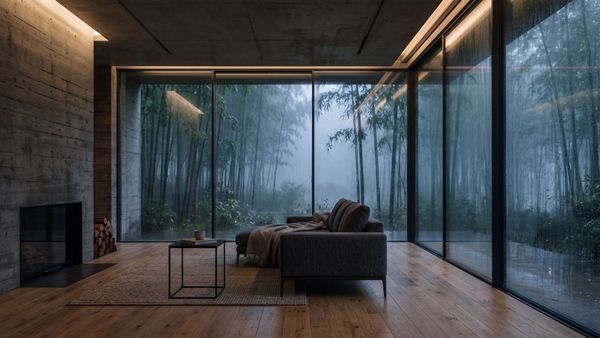
To facilitate this exact transition, I have engineered a 26-minute Non-Sleep Deep Rest (NSDR) protocol, conceptually set within a midnight Tokyo penthouse.
It is designed to insulate you from the noise of the day, using profound visual and auditory stillness to signal safety to your nervous system. If your mental bandwidth is saturated, do not try to force sleep. Stop trying to think your way into relaxation.
Press play, outsource your executive function, and allow the protocol to manually step your biology down into deep rest.